

LANTERN WITH NO WALLS
Lantern With No Walls with Saodat Ismailova, Masbedo, Adrian Paci, Thao Nguyen Phan, Janis Rafa and Daniel Steegmann Mangrané
curated by Leonardo Bigazzi, Alessandro Rabottini and Paola Ugolini
December 13, 2024 – January 26, 2025
Tarmak22
Gstaad-Saanen Airport, Oeystrasse 29
3792 Saanen, Switzerland
Lantern With No Walls is open every day from 11am to 6pm. Free entry
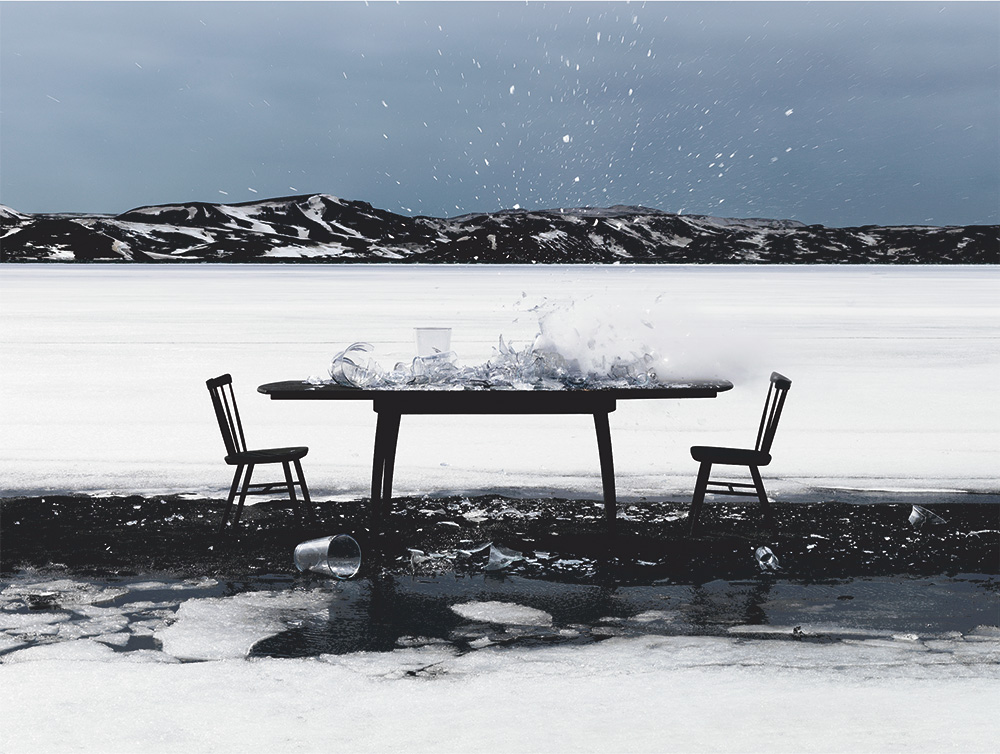
Masbedo, Teorema d’incompletezza, 2008. Still from video. Courtesy the artists. Fondazione In Between Art Film Collection
Fondazione In Between Art Film presents the group show Lantern With No Walls, an exhibition event conceived in response to the evocative landscape of the Bernese Alps that surround the town of Gstaad in Switzerland.
For the first time, the Fondazione is showcasing a selection of works from its own collection, which is focused exclusively on the numerous expressions of the moving image in the field of contemporary art, including more than 130 artist’s films, video installations and single-channel works.
Through the selection of six video works by international artists including Saodat Ismailova (1981, Uzbekistan), Masbedo (Nicolò Massazza, 1973 and Iacopo Bedogni, 1970, Italy), Adrian Paci (1969, Albania), Thao Nguyen Phan (1987, Vietnam), Janis Rafa (1984, Greece), and Daniel Steegmann Mangrané (1977, Spain), the exhibition offers a significant insight into the dynamics underpinning the collection owned by the Fondazione, which arose out of the desire on the part of its founder and president Beatrice Bulgari to support artists, scholars and institutions committed to exploring the expressive potential of moving images and the intersections between different artistic disciplines. The six works are placed in dialogue with each other against the backdrop designed by the interdisciplinary studio 2050+, founded by Ippolito Pestellini Laparelli.
At the center of the narrative of each work on view is the idea or the image of a landscape––be it a fragment of a mountain, of countryside, of a river or a forest––inhabited by symbolic or earthly life forms, human and non-human, existing in the present day or emerging from the horizons of history. In each work, the real or imaginary landscape is traversed, explored, contemplated and transcended by the main characters in a sequence of scenarios within which the act of walking and that of existing in space give rise to metaphors on time, the human impact on the environment, the reverberation of the past in the present, and the immensity of the forms of life.
We find real landscapes that mutate into existential scenarios: from the rocky expanses of Uzbekistan in the work of Saodat Ismailova, to the frozen wastes of Iceland in the Masbedo video; from the Albanian mountain road in the two-channel video installation by Adrian Paci, to the banks of the Mekong River in the film by Thao Nguyen Phan. In other works, nature seems to be a human construction, originating from a staging, as in the Janis Rafa video, or from a product of technology, as in Daniel Steegmann Mangrané’s computer-generated animation.
Lantern With No Walls serves as a “panorama of panoramas,” a mosaic of landscapes and scenarios that blend into each other and imply a continuous osmosis between past and present, human and non-human, individual existence and collective existence. The symbolic form of the lantern evokes the need for a light source that allows us to traverse both the landscape and life itself, even when the clouds seem to be gathering on the horizon.
Beatrice Bulgari, founder and president of Fondazione In Between Art Film, states: “This new exhibition by the Fondazione brings together works by artists whom I admire and who continue to inspire me, in a place as inspiring as Gstaad. The magnificence of this landscape, and the silence and contemplation that it induces in those who are immersed in it, form an ideal context in which to give the public access to works in the collection that address important themes with great subtlety, as if whispering. I hope that the local community and the international audience alike will appreciate these powerful, heartfelt visions of the artists on show, as well as the experience that we have endeavored to orchestrate by placing these works within the elegant spaces of Tarmak22.”
Lantern With No Walls is a further step on the journey of experimentation into the relationship between moving images and architecture, on which the Fondazione set out with the exhibitions Penumbra (2022) and Nebula (until November 24, 2024), both staged at the Complesso dell’Ospedaletto in Venice. In both of these cases, the aim was to “flesh out” the moving images and immerse visitors in a space in which sounds, images, materials and spatial interventions combine to make the viewing of the works a more perceptual and three-dimensional experience.
In Gstaad, as elsewhere, the interdisciplinary studio 2050+ was invited to conceive the set design for the exhibition and to bring its title to life in the form of a piece of temporary architecture. Via the use of semi- transparent materials and hanging structures that mark out the circular movement of visitors through the various rooms, the set design conjures up the image of a lantern: a lightweight and semi-luminous space, animated by shadows and sounds, glowing and vibrating with stories, within which the multiple echoes of the works form a punctuated, suspended sound environment.
THE WORKS
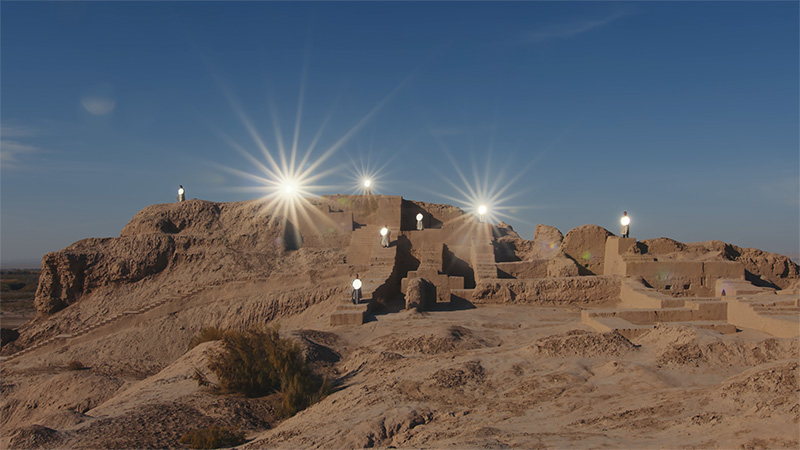
Saodat Ismailova
Melted into the Sun (2024)
Single-channel video, color, 5.1 sound, 35’50”. Commissioned and produced by Fondazione In Between Art Film, and co-produced by Batalha Centro de Cinema, Porto, for the exhibition Nebula at the Complesso dell’Ospedaletto, Venice.
Courtesy the artist and Fondazione In Between Art Film. Fondazione In Between Art Film collection
The films of Saodat Ismailova (1981, Uzbekistan) explore the historically complex and multilayered history of central Asia as it finds itself at the crossroads of a plethora of material histories and migratory heritages.
Melted into the Sun (2024) is inspired by the ambiguous figure of Al-Muqannaʿ (“The Veiled One”), a fuller who became a spiritual leader and political agitator in southern Central Asia in the 8th century. The film meditates on the cultural and political echoes of his revolutionary ideas about the sharing of property and wealth. Adopting a cyclical vision of history and knowledge, the artist transports us to the banks of the Amu Darya River, the circular burial ground of Chillpiq, and the city of Bukhara—all sites where the legendary exploits of Al-Muqannaʿ are said to have been performed. But Ismailova also takes us to places that are home to a number of pieces of Soviet infrastructure, such as the Kirov dam, and the solar furnace of Uzbekistan. This visual journey through time betrays the skilled use of illusion and science made by Al-Muqannaʿ for demagogic purposes, and considers the central role played by technology and the manipulation of the Earth. The lyrical sequences of reflections and flashes, together with the textured soundtrack, continue to make his profound and still-unanswered questions reverberate into the modern day.
The work of Saodat Ismailova has been shown in solo exhibitions at Pirelli HangarBicocca, Milan; Le Fresnoy, Tourcoing; Eye Filmmuseum, Amsterdam; the Center for Contemporary Art Tashkent; Tromsø Kunstforening; The Kunstsammlungen & Museen Augsburg, besides many group shows. In 2022, she received the l’Eye Prize for Art and Film, Amsterdam.
Masbedo
Teorema d’incompletezza (2008)
Single-channel video, color, sound, 5’38”. Courtesy the artists. Fondazione In Between Art Film collection
Video, installation, film and performance are the mediums with which Masbedo (Nicolò Massazza, 1973, and Iacopo Bedogni, 1970, Italy) enact the tension between inner world, culture and History. The theme of incommunicability is at the center of the work on view, set in Iceland, where ice and lava serve as a metaphorical representation of mutual incomprehension. This natural world, indifferent and hostile to human events, plays host, paradoxically, to a kitchen table, symbol of domestic intimacy, complete with glass dishes and utensils that are destined, over the course of just a few minutes, to shatter, as do the chairs and the table itself. We hear the words of a man and a woman continually interrupted by the violence of the scene. The choice of Iceland, an island located on the far edge of Europe, manifests the feeling of solitude alongside the relationship between beauty, alienation and mystery. Created by the collision of the North American and Eurasian plates, this land is crossed by a long geological fault which, opening up by a further 3 centimeters every year, is gradually lacerating it. The landscape thus embodies the feeling of inner breakdown and relational distance, as well as a sense of the inexorable ruination of things.
The works of Masbedo have been exhibited at international institutions and biennales including Manifesta 12 and Manifesta 15; MAXXI, Rome; the Museo del Novecento and Fondazione ICA, Milan; the Centre Pompidou-Metz; the Fondazione Merz, Turin; the Hong Kong Arts Centre; and the Leopold Museum, Vienna. Their films have been screened at the Venice Film Festival, the Locarno Film Festival; FIFA, Montréal; CPH:DOX; Sharjah Film Platform; the Walter Reade Theater, New York; Lo schermo dell’arte, Florence; and IFFR, Rotterdam.
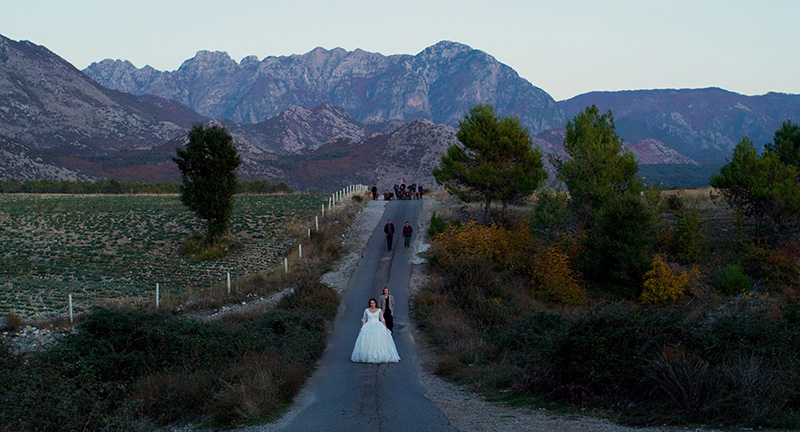
Adrian Paci
The Wanderers (2021)
Two-channel video installation, B/W and color, sound, left channel 34’40”, right channel 8’40”. Courtesy the artist; kaufmann repetto, Milan/New York; Peter Kilchmann Gallery, Zürich. Fondazione In Between Art Film collection
The two-channel video installation by Adrian Paci (1969, Albania) is a metaphorical reflection—conceived during the years of the COVID-19 pandemic—on the relationship the individual, the community, and time. The images take us to modern-day, rural Albania, with glimpses of different landscapes and the countryside that surrounds Scutari, the artist’s home town. In the projection on the left, in limpid black and white, human beings and animals are filmed in slow motion as they cross a snowy, half-deserted street. In the projection on the right, in color, the movement of the figures along the road becomes more intense and frequent, as they appear in the frame only to then disappear from it shortly after. While on the left the lens follows the direction of movement, advancing together with our gaze and with the arrow of time from the present to the future, on the right the camera retreats, allowing the figures to emerge in the visual field only for them to then be immediately swallowed up by memory. Paci paints a sorrowful portrait of humanity caught between solitude and the need for belonging, transforming the action of walking into a metaphor for the flow of existence, the abandonment of places, and the survival of memory. The work establishes a narrative through images, in which the relationship between History and individual existences transcends the presence of verbal language.
Adrian Paci’s most significant solo shows have been held at institutions including Jeu de Paume, Paris; PAC, Milan; MAC, Montréal; and MoMA PS1, New York. He has participated in numerous international biennales, including the Biennale Arte, the Biennale of Sydney, Manifesta 3 and Manifesta 14.
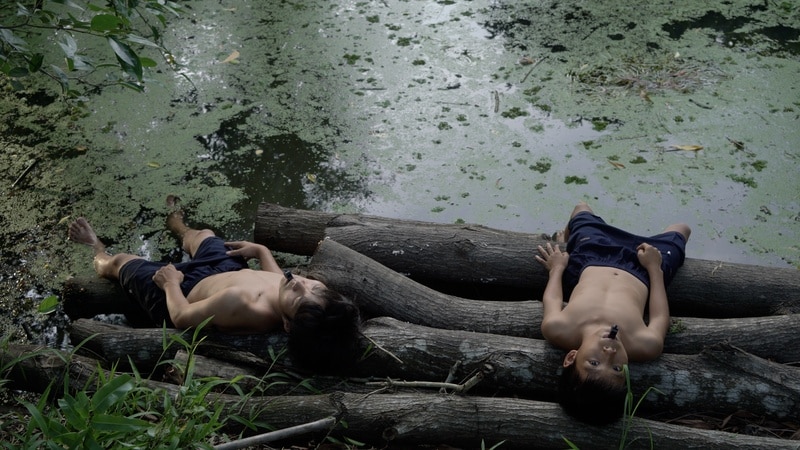
Thao Nguyen Phan
Becoming Alluvium (2019–in corso)
Single-channel video, color, sound, 16’40”. Commissioned and produced by Han Nefkens Foundation in collaboration with Fundació Joan Miró, Barcelona; WIELS – Contemporary Art Centre, Brussels; and Chisenhale Gallery, London. Fondazione In Between Art Film collection
Through video, drawing, and sculpture, Thao Nguyen Phan (Vietnam, 1987) fuses History with imagination and looks at those moments in which the echo of the past can be felt in the present. Becoming Alluvium (2019–in progress) is a work that looks at the Mekong River as a theater for social, political, environmental, and spiritual change across the centuries. Divided into three chapters, the work is an allegorical meditation on the concepts of destruction, reincarnation, and renewal. The first chapter evokes the collapse of a dam and the fatal consequences for the villages downstream, through the reincarnation of two adolescent brothers as a dolphin and a water hyacinth. The second chapter is interwoven with images of modern, everyday life along the banks of the river, accompanied by extracts from the 1984 autobiographical novel, entitled The Lover, by Marguerite Duras (in which the writer describes her adolescence spent in French Indochina, today’s Vietnam), and from Italo Calvino’s story collection Invisible Cities, thereby expanding the exploration of the themes of travel and distance through the prism of literary invention. The final chapter reworks a local folktale that has as its protagonist a princess and which recounts her wish that human beings may recreate the beauty of nature through the manufacture of jewelry. Phan creates a story that mixes up different timescales and visual languages, combining her love for tradition with her fears over the climate emergency and her understanding of the effects of the colonial past on the present.
Solo exhibitions of Thao Nguyen Phan’s work have been held at institutions including Pirelli HangarBicocca, Milan; Tate St Ives; WIELS–Contemporary Art Centre, Brussels; the Rockbund Art Museum, Shanghai; and Chisenhale Gallery, London. She has also participated in the Biennale Arte; the Lyon Biennale; the Sharjah Biennial; and the Dhaka Art Summit.
Janis Rafa
Winter Came Early (2015)
Single-channel video, color, sound, 3′. Courtesy the artist. Fondazione In Between Art Film collection
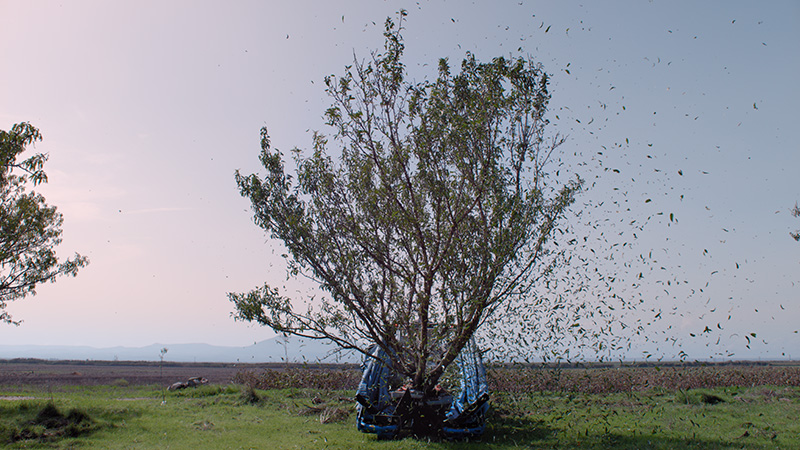
Using film, installation, sculpture, writing and drawing, Janis Rafa (Greece, 1984) explores the relationship between mankind and nature, highlighting the fact that within this relationship the former dominates the latter. Situating her perspective on the margins of urban reality, the artist produces disquieting narratives shot through with an atmosphere suspended between dream and realism, within which we bear witness to forms of contact between human, animal, and plant beings, in which the line separating care and control becomes blurred. In the work on view, we see the violent action of a vehicle that, for ten interminable seconds, shakes an almond tree vigorously, causing its leaves to fall prematurely. Using a high-speed video camera shooting at 2000 frames per second, Rafa creates a glaring, melancholy metaphor that evokes a multiplicity of themes: from the unconditional exploitation of the environment by the human race, to the fragility of the equilibrium that we think we are establishing between nature and technology, all the way to the ineluctable transience of all forms of existence. The surreal character of the situation to which we are spectators is indicative of Rafa’s artistic vision, which is characterized by meticulous enactments that capture the tension between the element of sensuality and the presence of something disturbing, between what looks like a slice of reality and what, in contrast, is the result of cinematographic fiction.
Janis Rafa has exhibited her works at institutions including the Eye Filmmuseum, Amsterdam, and at the Biennale Arte. She has a PhD in Visual Arts and has completed residencies at Onassis Air, Artworks S. Niarchos Foundation, and the Rijksakademie, Amsterdam. In 2025, she will present a new set of works at a solo show to be held at EMΣT–the Museum of Contemporary Art, Athens.
Daniel Steegmann Mangrané
A Dream Dreaming a Dream (2020)
Single-channel video, real time CGI animation, B/W, sound, infinite duration. Commissioned and produced for St_age by Thyssen-Bornemisza Art Contemporary – TBA21. Fondazione In Between Art Film collection
The extent to which the relationship between nature, human intervention and technology is not solely one of coexistence and exploitation but also one question of mediation and representation is the theme at the center of the work of the Spanish artist Daniel Steegmann Mangrané.
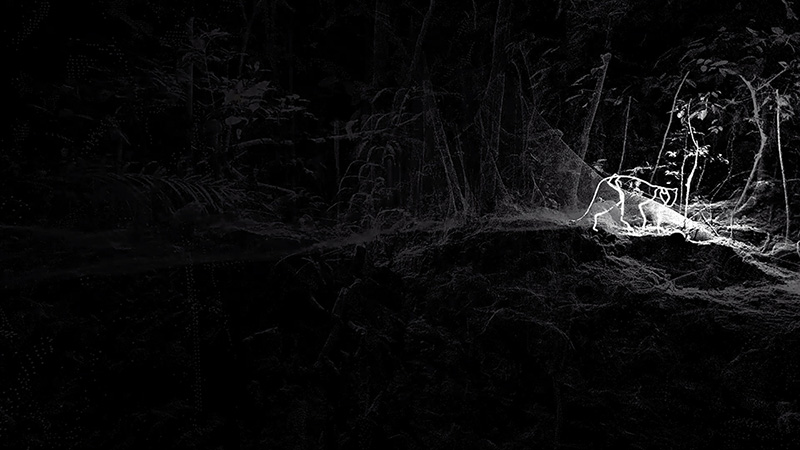
An electric, luminous being with the features of a panther roams through the lush Mata Atlântica, the first region that the Portuguese colonists came to in the early 16th century when they reached Brazil. Deploying generative artificial intelligence, the artist produces a never-ending animation, within which the movements of this animal figure are determined randomly by the algorithm, enabling it to exist and move around in the environment even when the work is not being projected, thereby prefiguring the possibility of life forms that are not dependent on any human presence. Scanning sections of forest with a system of tracking cameras, the artist obtained extremely vivid and realistic 3D images, which contrast with the pared-back graphical rendering of the panther. The animal has the ability to illuminate the natural world in which it is immersed by moving around within it, and this power of emanation that it has creates a synthesis of past and present. On the one hand, we are facing a present and future scenario that entails the radical modification of nature on the part of mankind, while on the other we are reconnecting to the concept that indigenous Brazilian cultures had, and still have, of nature and its creatures as manifestations of the divine.
Daniel Steegmann Mangrané’s work has been shown in solo shows held at Kiasma, Helsinki; MACBA, Barcelona; Pirelli HangarBicocca, Milan; Nottingham Contemporary; and the Serralves Museum of Contemporary Art, Porto. His work has also appeared in group shows at MoMA, New York; Hamburger Bahnhof, Berlin; Jeu de Paume, Paris; the Liverpool Biennial 2021; Para Site, Hong Kong; the Taipei Biennial 2020; the Dhaka Art Summit 2020; the Hayward Gallery, London; the Kunstmuseum Stuttgart; the 14th Lyon Biennale; and the Arario Museum, Seoul.