

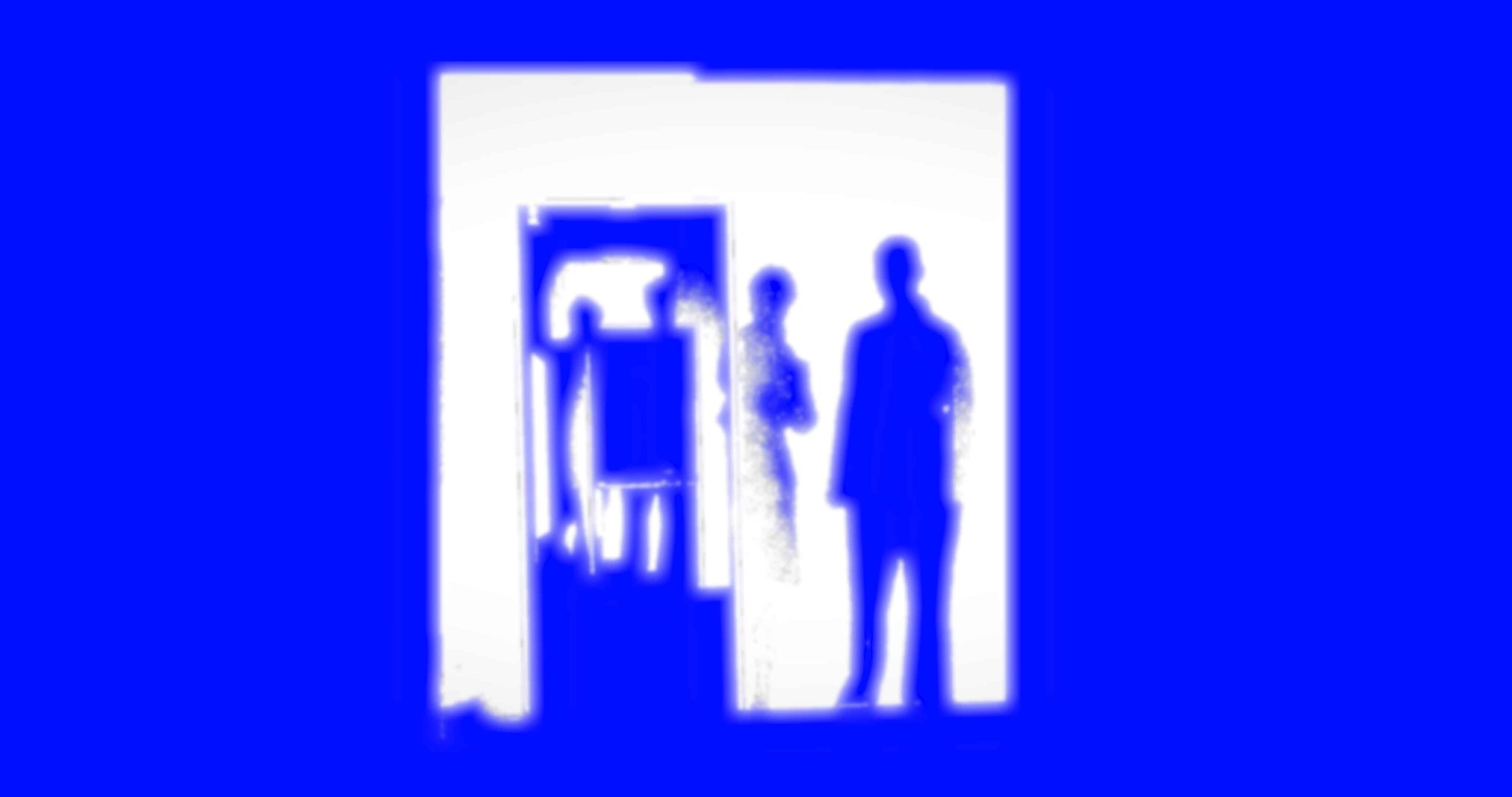
TERMINAL LUCIDITY
2026, Site-specific single-channel video and light installation, colour, sound, infinite duration.
Commissioned and produced by Fondazione In Between Art Film, co-produced by EMMA – Espoo Museum of Modern Art with support from the Saastamoinen Foundation, for the exhibition Canicula, 2026. Courtesy of the artist; Commonwealth and Council, Los Angeles; Fondazione In Between Art Film; Galerie Sultana, Paris.
P.STAFF
P. Staff (1987, United Kingdom) is an artist based in Los Angeles and London. Staff’s work has been presented internationally at institutions such as the Bonner Kunstverein; Serralves, Porto; the Whitney Biennial 2024, New York; the Kunsthalle Basel; MOCA, Los Angeles; the Biennale Arte 2022, Venice; the Institute of Contemporary Art, Shanghai; the Serpentine Gallery, London; the Chisenhale Gallery, London; and the New Museum, New York. They have received the Louis Comfort Tiffany Award, the Tate Liverpool/Keith Haring Foundation Artist Research Fellowship, and the Paul Hamlyn Foundation Award for Visual Arts.
“Terminal lucidity” is an expression used to describe an unexpected return of consciousness, mental clarity or memory shortly before death. Drawing from this physiological phenomenon and in dialogue with the previous function of the Complesso dell’Ospedaletto as a care home, the work assembles visual, sonic and spatial elements into a single perceptual environment that extends to the adjacent monumental helicoidal staircase. The interplay of light and darkness, sounds and images is a conduit to explore perception as both medium and site, however immaterial and interior. Sequences of white silhouettes against highly saturated coloured backgrounds, chosen for their capacity to exhaust the eyes, get briefly wedged into the film’s continuous darkness. When the latter reappears, so does the previous silhouette, this time only in our eyes, as an afterimage. Due to the involvement of different photoreceptors in our retinas, white forms persist more or less intact as ghostly presences but their backgrounds transform into vivid complementary hallucinations – red into cyan or yellow into violet – which do not correspond to what is on the screen. And yet, a new and inner only reality made of apparitions occurs. Here vision is transformed from passive observation into the active creation of images that pertain to dreams and fantasies. The soundtrack combines collaged sequences of varying musical compositions, from orchestral pieces, to handclaps and ambient sounds recorded in Venice, together with oneiric sections of muffled room tones and distant rings that participate in the work’s dialectics of sensory exhaustion and relief. Situated between structural film and expanded cinema, this ambience was developed in collaboration with composer Lukas Frank and lighting designer Josephine Wang in response to the constant yet random algorithmic shuffling of the film’s segments. The video installation suggests a liminal space between life and death, an uneasy world permeated by sensory deceptions. Here, the artist explores whether a film, let alone reality itself, can take place entirely within the space of optical illusion – in the eye of the viewer, once plunged into darkness.